
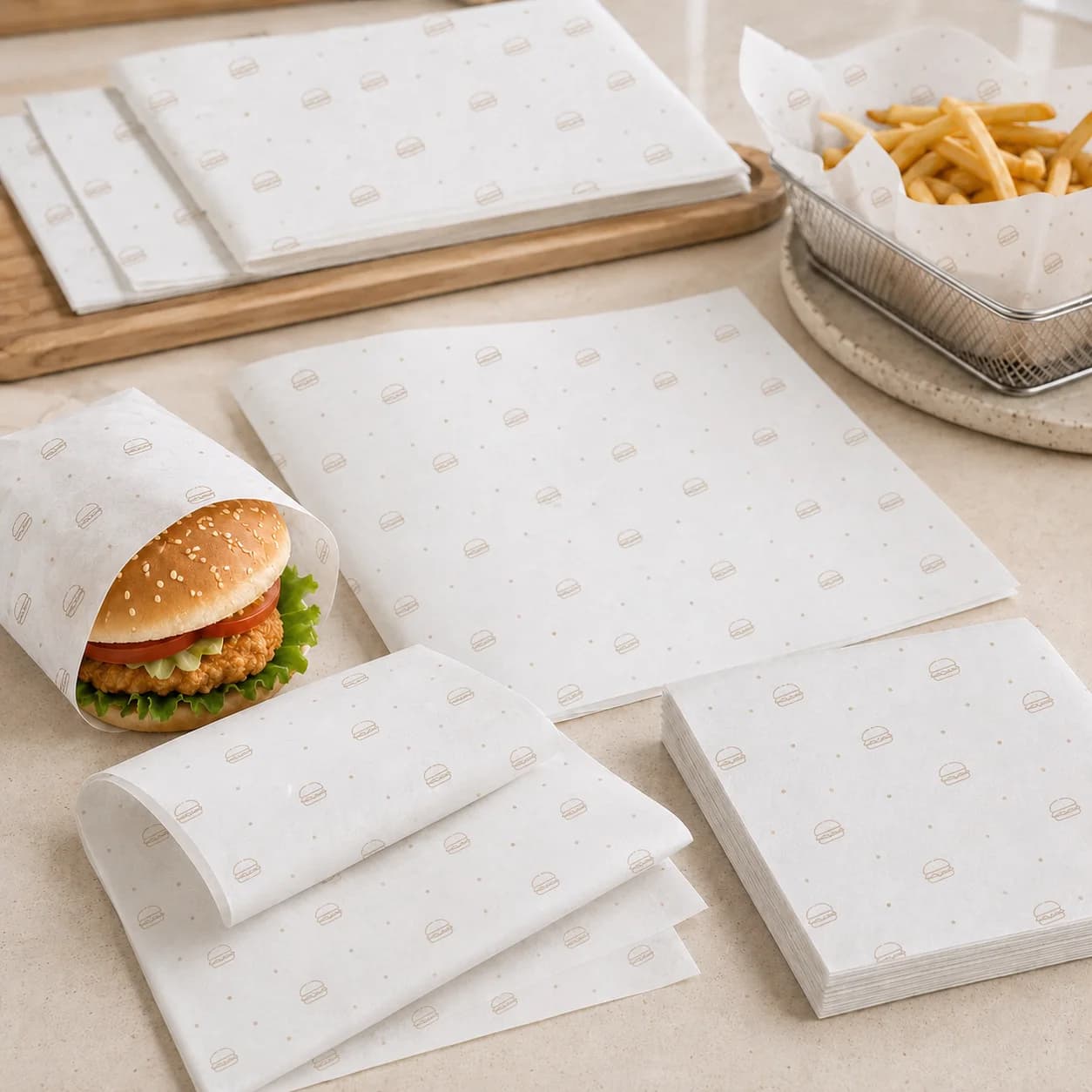
Custom burger wrapping paper works best when sheet size, material performance and print layout are planned together. Choosing a common burger wrapper size first and adding a logo later can create poor folds, hidden artwork or unnecessary paper waste.
Use the steps below to prepare a clearer specification for quotation and sampling.
1. Define how the paper will be used
Begin with the packaging job, not the artwork. Burger paper may be a full wrap, partial wrap, tray liner, basket liner or presentation sheet.
Tell the supplier:
- the food type and approximate dimensions;
- whether the food is hot, oily, saucy or moist;
- whether staff fully wrap or simply line the package;
- the expected holding time for dine-in, takeaway or delivery;
- whether another box, tray or basket is used with the paper.
These details influence the finished sheet size and the required grease, moisture and wet-strength performance.
2. Measure the finished sheet, not only the burger
A burger diameter is not enough to calculate a wrapping sheet. Bun height, toppings, folding sequence and overlap also require space.
If you already use burger paper, flatten an unused sheet and measure its width and length. Photograph a wrapped burger from the top and side. For a new format, provide the food dimensions and folding method so a trial size can be proposed.
Published stock products commonly include square and rectangular sheets such as 12 × 12, 14 × 14 and 15 × 16 inches, as well as metric formats around 330 × 380 mm. These are market references only. A custom project should use the size that fits the actual food and service process.
3. Match material performance to the food
The same size can be produced with different paper structures. The appropriate route may be natural greaseproof paper, a treated or barrier-coated sheet, waxed tissue or another laminated structure.
Do not choose by grammage alone. Confirm the food, temperature, grease level, contact time and destination-market requirements before selecting material. Xucheng can coordinate project-specific grammage; the final paper and barrier requirement are confirmed before custom sampling.
4. Choose a print layout that still works after folding
A repeating logo pattern is usually flexible because the brand remains visible across different folds. A fixed-position design needs more accurate registration between the sheet, food position and wrapping method.
Before final artwork, decide:
- repeating pattern or fixed-position layout;
- logo size and spacing;
- number of print colors;
- background coverage;
- print direction during wrapping;
- whether any text must remain visible after folding.
Heavy ink coverage, tight color matching and fixed-position artwork may affect feasibility, cost and MOQ. Discuss these points before ordering a sample.
5. Prepare usable artwork
AI, PDF or EPS vector artwork normally gives the cleanest starting point. Convert fonts to outlines or include the font files, and provide intended color references when color accuracy matters.
A JPG or PNG can begin the discussion, but a low-resolution image may need to be recreated. Do not rely on a screenshot of a logo for final production.
The target for the first digital mockup is within 3 hours during China working hours after usable artwork is received. This target begins after the file, size and basic project requirements are clear.
6. Approve the physical result before bulk production
A digital mockup checks position and appearance. A physical sample is still needed to assess folding, paper feel, grease resistance and how print looks on the selected material.
Available stock samples are free, with freight paid by the buyer. Custom printed samples are charged first, and the fee is credited after a bulk order. After visual approval and payment of the sampling fee, the target is to dispatch the custom sample within 7 days.
Burger paper quotation checklist
- Food type and dimensions
- Full wrap or liner
- Finished sheet width and length
- Estimated quantity
- Grease, moisture, heat and holding-time requirements
- Natural, white or other preferred appearance
- Print colors and coverage
- Repeating or fixed-position layout
- Artwork file
- Delivery country and required documents
Frequently asked questions
Can every project use a repeating logo?
A repeating pattern suits many wraps, but logo scale and spacing should be tested after folding. Adjust the layout to the finished sheet and real wrapping method.
Can I copy a competitor’s paper size?
A published size can be a reference, but the final sheet should be based on your burger, folding method and service process.
How many colors can I print?
Feasibility depends on material, artwork, coverage and production route. Send the artwork so a practical color plan can be confirmed instead of assuming one universal limit.
Prepare your burger paper project
View our custom burger paper and custom greaseproof wrapping paper, or send Lynn the food dimensions, sheet size, quantity, artwork and delivery country.