
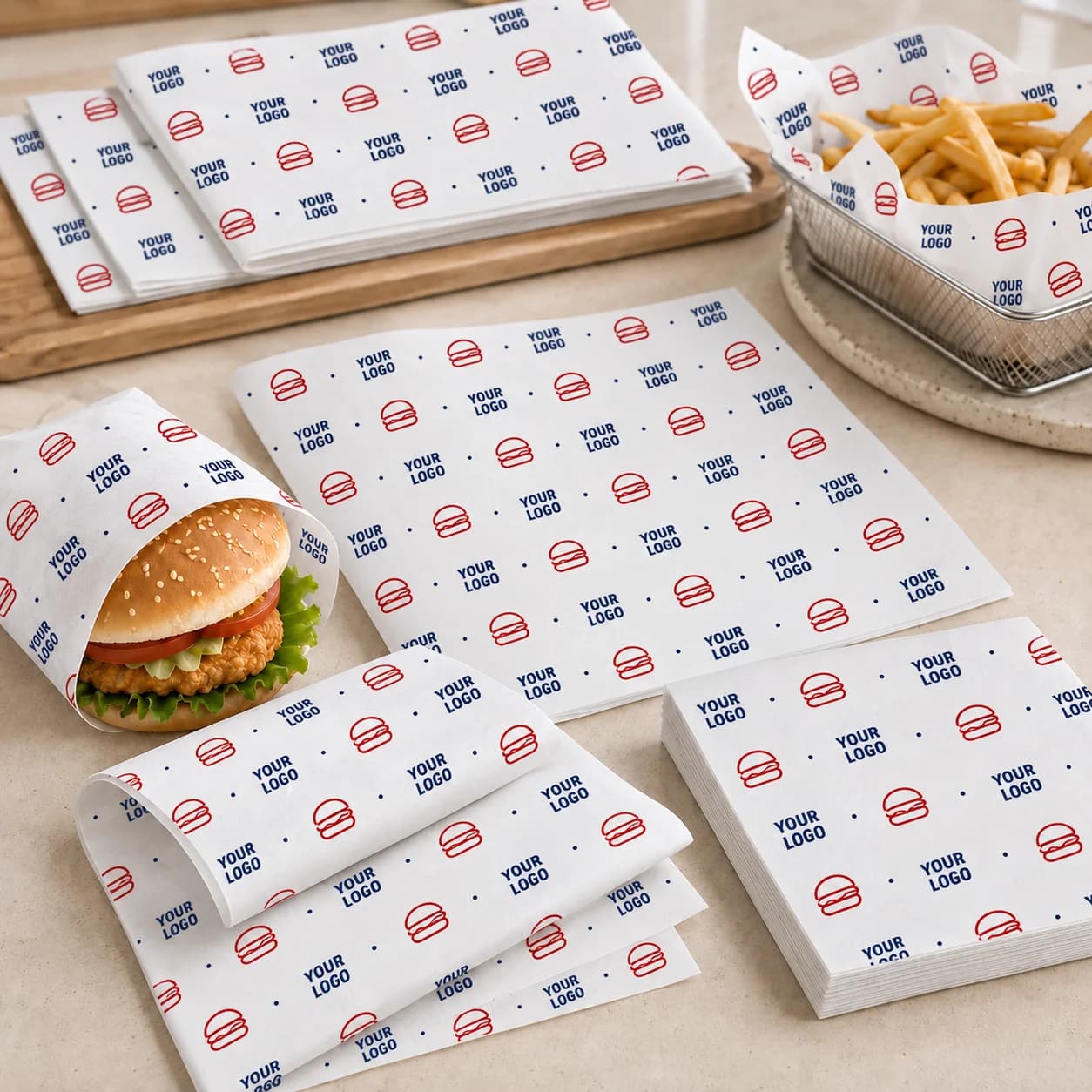
Compare custom food wrapping paper quotes using the same finished sheet, paper requirement, artwork and delivery scope. Then check the quantity for each size and design. A lower price per sheet is only useful when that sheet does the same packaging job and the quotation includes the costs you need to compare.
For burger shops, sandwich counters and packaging distributors, the practical starting point is a photo of the food or current wrap, approximate quantity and delivery destination. You can ask for a proposal before every specification is settled. As the options become clearer, use the comparison below to choose the order that fits your operation.
Put the same finished product on each quotation
Start with the item staff will take from the pack: a finished, pre-cut wrapping sheet. Record its width and length, the food it touches and whether it encloses the food or lines another package. Keep the same units across quotations. A width in inches on one offer and millimetres on another should be converted before comparison; one inch equals 25.4 mm.
Separate dimensions from paper performance. Two sheets with identical dimensions and grammage can have different constructions and behave differently around grease, moisture and folds. Ask each supplier to identify the proposed paper and intended contact conditions rather than treating the word “greaseproof” as a complete match.
Keep quotations for alternative materials in separate rows. That lets you compare a proposed change without accidentally treating it as an equivalent replacement. A photograph can explain appearance and use, but it cannot establish the material construction or confirm food-contact suitability.
Use the burger paper size and printing guide to resolve a fold or artwork question. For mixed sandwich menus, the sandwich sheet-size guide helps decide whether one or several sizes are appropriate. Once that decision is made, bring the selected specification back to the quotation.
Check what “one sheet” and “one case” mean
Ask whether the quoted quantity counts finished pieces ready for use or larger sheets that will be cut. If cutting is included, confirm the finished dimensions and total delivered pieces for each design. The number of printable layouts on a larger sheet is not automatically the number of usable wrappers you will receive.
For a case price, record packs per case and sheets per pack. Do not assume every supplier uses the same case count or that “ream” identifies a particular delivered quantity. Also check whether packing quantities describe one artwork or a mixture.
Finished sheets per case = packs per case × finished sheets per pack.
For example, 20 packs containing 500 finished sheets each total 10,000 sheets. Ten packs containing 500 each total 5,000. This is a counting example, not a Xucheng packing specification. Comparing those two case prices without converting the quantities would hide a twofold difference in the amount of paper.
Comparable goods cost per 1,000 sheets = quoted goods amount ÷ finished sheet count × 1,000.
Use that calculation only after checking that the specifications, currency and included charges match. Keep freight and other quoted charges visible instead of silently adding them to one offer and leaving them out of another.
Split the order by size and artwork before applying the MOQ
A combined quantity does not explain how an order will be produced. List each finished size, paper specification and artwork revision separately, then ask how the minimum applies to that combination. Different suppliers or production routes may treat these splits differently.
For Xucheng paper projects, the current MOQ guide starts at 10,000 pieces. The quotation confirms how the selected specification and artwork split apply. It is not a promise that any combination of small runs can be combined into one minimum, or that every size has the same price.
An illustrative order breakdown might be:
| Order line | Packaging job | Artwork | Planned finished quantity |
|---|---|---|---|
| A | Regular burger wrap, agreed sheet size | Main brand design | 8,000 sheets |
| B | Same size and paper | Seasonal design | 2,000 sheets |
| C | Longer sandwich wrap, separate size | Main brand design | 4,000 sheets |
The total is 14,000 sheets, but the supplier still needs to assess three lines. These example quantities do not imply accepted minimums. Ask whether the proposed split is feasible, whether a shared design changes the quotation and what would change if the seasonal run were postponed.
If one design will work across several menu items, combining the artwork may simplify replenishment. Keep separate sizes when they solve a real wrapping problem. Buying fewer versions is not a saving if staff then need a second sheet or struggle with excess folds during service.
Match print scope, samples and one-time charges
“Printed with your logo” can describe different results. Specify the artwork revision, color references, printed side, approximate coverage and repeating or fixed-position layout. Ask for the quote to identify the proposed print arrangement. Keep any alternative design clearly labelled so you can see what changed with the price.
Ask which charges are included and which are separate: artwork preparation, setup or plates where applicable, custom samples, sample courier, cutting and packing. A charge may be included in the goods price rather than listed separately. Confirm the first order and repeat-order basis instead of assuming that an initial fee will always disappear or always recur.
Distinguish the visual proof from the physical sample. A digital proof lets you review layout and wording; it does not demonstrate how the finished paper performs around your food. Record what sample is proposed, whether it uses the intended paper and print, and which changes would require another review.
Xucheng's custom printed samples are charged, with courier costs paid by the buyer; the custom sample fee is credited against the formal order. Ask for the applicable sample and order amounts to be shown clearly, so a later credit is not counted twice. Photos and an initial logo file are enough to begin discussing the project while final artwork is prepared.
Compare delivery to the same place and stage
Give the destination country and postcode, required receiving date and whether the order goes to one location or several. Ask each quotation to name the delivery point, transport scope and any amounts still to be confirmed. A factory dispatch date and a date at your receiving address answer different questions.
Keep the goods amount, quoted transport charges and other stated charges in separate fields. Ask who will handle any import or local delivery requirements for the proposed arrangement. An unspecified cost remains an open item; it should not become zero in a comparison.
For repeat orders, check the replenishment sequence as well as the first shipment. Confirm when artwork approval, sampling, production and dispatch are expected to occur. Leave room for your own sample assessment and receiving process rather than treating every quoted lead time as starting on the day you send an enquiry.
Use a short comparison table to make the decision
Put each supplier's answer alongside the same requirement. A quotation with one unresolved field can remain under consideration while that field is clarified; you do not need to restart the entire enquiry.
| Compare | Put on the same basis | Resolve before approving the order |
|---|---|---|
| Finished sheet | Width × length and finished-piece count | Any cutting, size or quantity ambiguity |
| Paper and use | Proposed construction and food-contact conditions | Suitability for the intended food, hold and destination |
| Artwork | Revision, colors, layout and printed side | Differences in coverage or positioning |
| Order split | Quantity by size, paper and design | How the minimum applies to each line |
| Samples and setup | Included items, separate charges and credits | What the physical sample represents |
| Packing | Sheets per pack, packs per case and version labels | Mixed designs or a different case count |
| Delivery | Currency, named destination and transport scope | Unquoted charges and dispatch versus receipt timing |
| Reorder | Approved reference and repeat quantity | Changed artwork, material, packing or delivery conditions |
First remove offers that cannot meet the agreed packaging job. Then compare the remaining costs and practical trade-offs. If an alternative could work, ask for it as a separate option with its changed specification visible. A cheaper untested paper is a proposal to assess, not an approved substitute.
Choose the right product for the quotation
For a full or partial burger wrap, start with custom burger wrapping paper. It keeps the quotation focused on the sheet, fold and print around the assembled burger rather than the dimensions of an outer box.
For long sandwiches, cut portions or a mixed café menu, choose custom sandwich wrapping paper. A separate size can be justified where it improves coverage or handling; specify the quantity for that size instead of blending it into a general paper total.
If a sticker identifies the item or holds a tested overlap, quote packaging stickers and labels as a separate component. State the wrapper surface and placement. The label does not replace missing paper coverage, and its quantity and construction should remain visible in the order.
Send what you have and ask for comparable options
Send Lynn the food or packaging photos, current sheet dimensions if known, quantity by size and design, artwork and destination. If you are comparing an existing offer, summarise its specification and the items you want clarified. You do not need to share another supplier's confidential document to request a comparable proposal.
The fillable wrapping-paper worksheet and editable Word version are optional ways to organise those details. Leave undecided fields open and add a photo where it explains the packaging more clearly.
Discuss a custom wrapping-paper quotation with Xucheng. Tell us whether the priority is matching the current wrapper, changing the artwork, combining quantities or reviewing another paper option. That gives the quotation a clear decision to support.