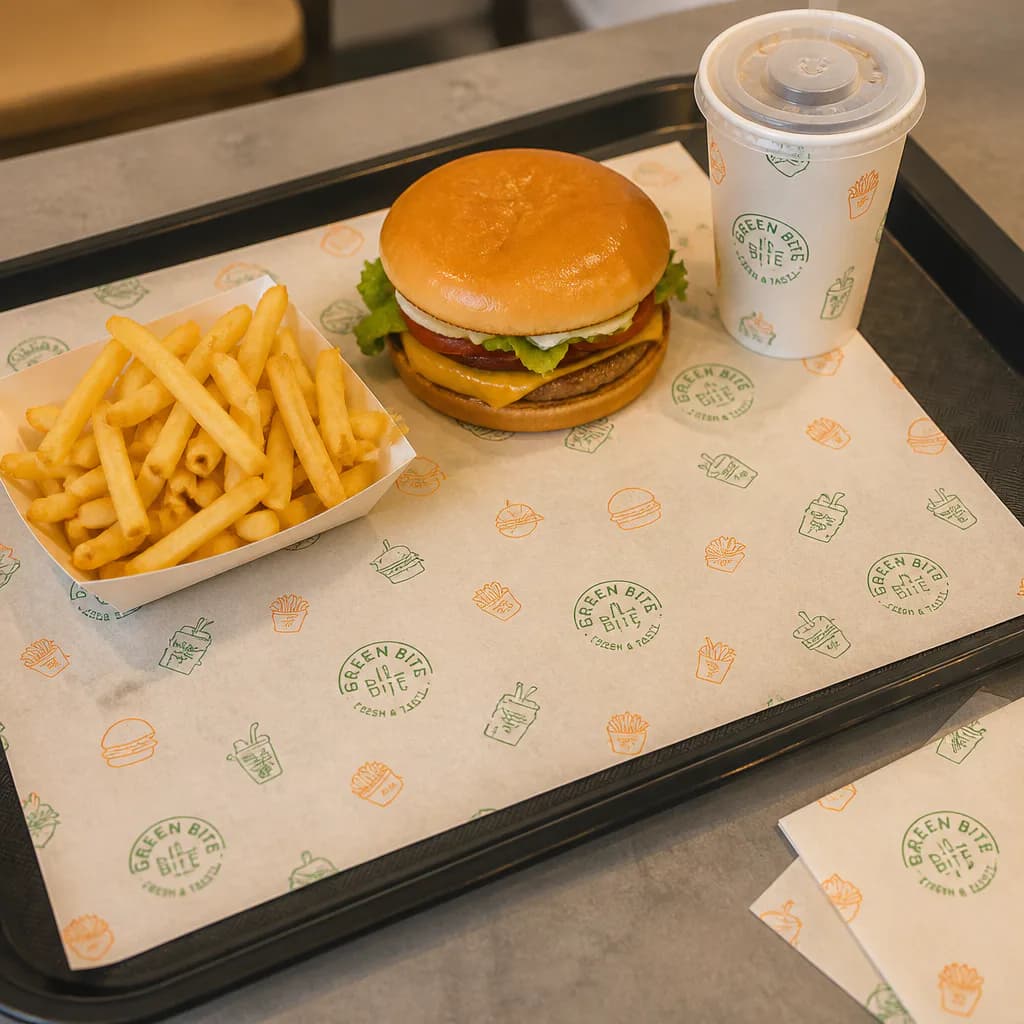
Printed presentation for a complete served meal
Bring your brand, menu message or artwork to the paper beneath a served meal. Custom paper tray liners are pre-cut flat sheets placed inside reusable serving and cafeteria trays. Xucheng Packaging coordinates the finished sheet size, paper route, print layout and packing around the tray and the meal it carries.
The liner adds a printed surface; the tray supplies the carrying structure. A burger box, fries carton and drink may cover much of the sheet, so the design needs to work in the areas customers can still see. The useful specification combines coverage, visible artwork and a sheet that staff can place during normal service.
You can start with the tray service or presentation you want to improve. Chat with Lynn on WhatsApp, or choose an email option, before you have measurements, photos, artwork, quantities or test results. Those details can follow as we develop the project.
Fit the paper to the serving tray before approving the artwork.
This product is a pre-cut flat sheet laid across the usable area of a large reusable serving or cafeteria tray used to collect and carry a meal. Choose the sheet dimensions around the tray base and full meal layout. For a smaller food basket, use that container as the sizing reference instead.
Common applications
- Fast-food meal pickup trays
- Cafeteria and food-court serving trays
- Café and bakery trays
- Hotel and event meal service
What can be customized
- Finished sheet size and corner profile
- Paper and surface route to confirm
- Repeat or fixed-position print
- Loaded-meal artwork visibility
- Stack and inner-pack format
Meal pickup and cafeteria service
A liner can give the complete meal a consistent printed setting as the customer collects the tray. Plan it around the arrangement used at your counter: a main pack, side, drink, napkin and cutlery can occupy different parts of the base. The paper should suit that arrangement rather than only looking centered on an empty tray.
If a restaurant uses more than one reusable tray, decide whether a shared sheet is useful or whether the tray shapes call for separate sizes. One liner may simplify replenishment when it sits properly in each tray. A second size is useful when it solves a real coverage or placement problem, rather than merely matching a different menu name.
A liner is separate from the food container
Closed packs, wrapped food and unpackaged food create different contact conditions. Paper beneath a closed carton still needs a suitable specification for its intended use; paper directly beneath hot or oily food needs its own food-contact review. A printed scene does not establish a barrier rating or approve direct contact.
The flat sheet does not become a formed food tray or replace the supporting container. If you need a carton that encloses or supports the food itself, compare takeaway food boxes. For smaller counter portions, pickup or basket-lining work, deli paper sheets address a different sheet and handling decision.
Develop the finished size around the usable base
The tray's overall length and width include areas the liner may not be able to use. Raised rims, sloping sides and rounded corners affect where a flat sheet will sit. A sheet specified only from the outside dimensions can climb a rim or gather at a corner even though the nominal size appears correct.
Review the intended coverage and the shape of the actual tray together. A margin around the sheet may help it lie naturally; maximum coverage is not automatically the best result. Any corner requirement needs to be stated with the finished dimensions and reviewed for the proposed converting route.
An existing successful liner is a useful starting reference when available. If there is no settled size, Lynn can discuss the tray and intended meal before a finished sheet is selected. The existing cafeteria tray-liner sizing guide covers inside measurements, corners and loaded fit in more detail; it is optional follow-up information, not a checklist to finish before contacting us.
Put the design in the customer's visible area
Custom artwork can be developed as a repeating pattern or a fixed-position layout. The better choice depends on how consistently the meal is arranged and which areas of paper remain exposed. Food and containers can hide a central logo that looks prominent on an unused sheet.
A repeated motif gives several possible viewing areas when staff place items differently. Its scale and spacing still matter: a very large repeat may leave only fragments around the meal, while small text may be hard to read at normal serving distance. Review the design at the proposed finished size.
A fixed-position logo, menu message or QR area needs a predictable visible panel and tray orientation. Consider how customers approach, carry and set down the loaded tray. Keep any essential information clear of the normal main pack, side and drink positions; a printable area is not necessarily a visible area.
If the sheet includes a QR code, check the finished printed and loaded result with the intended reader. A code that works on the digital artwork has not yet demonstrated readability beside the complete meal. The layout and final print review belong to the project specification, not a universal printing promise.
A complete loaded tray reveals the usable fit and visible print.
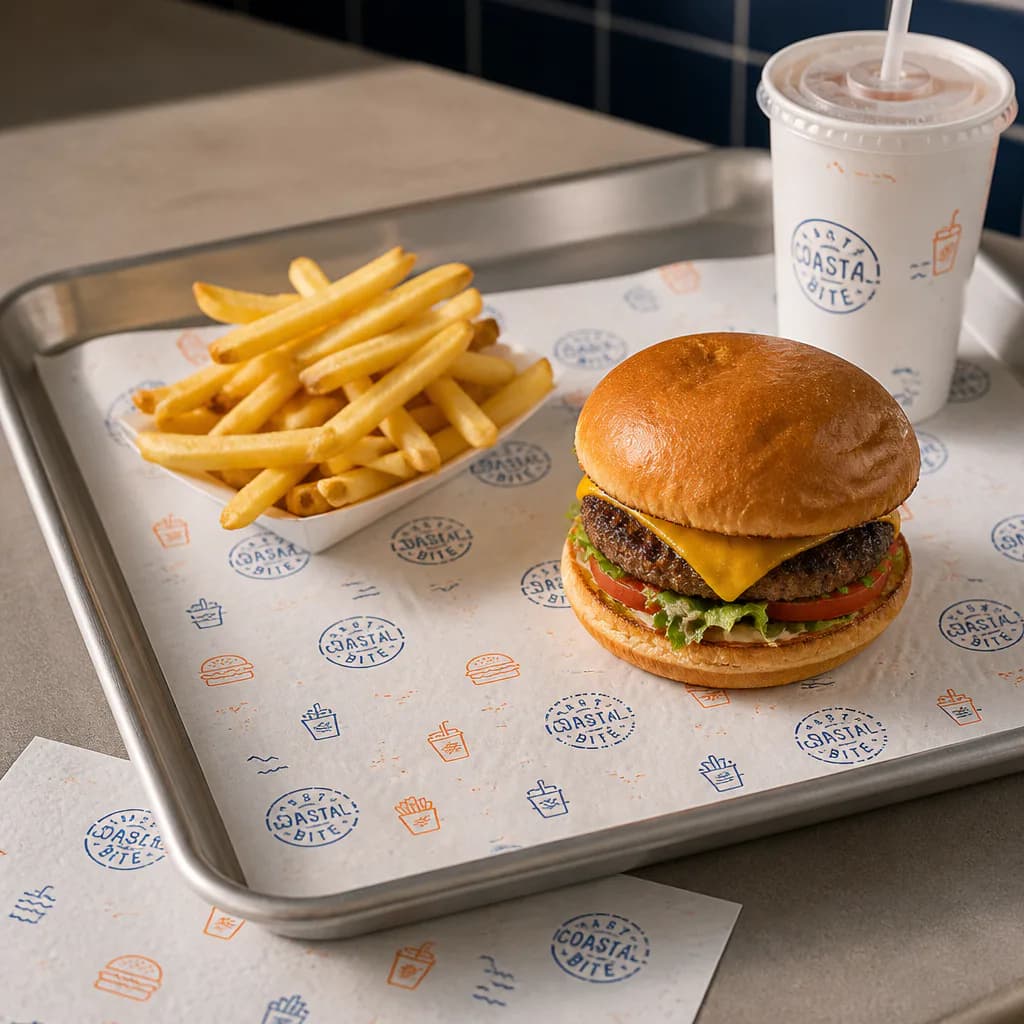
The usable inside area, corner shape, complete meal footprint and intended viewing direction are checked together before the finished sheet and artwork layout are approved.
The retained illustration shows one possible printed presentation on a reusable tray. It is not a customer order, a dimensioned drawing or proof of a selected paper's grease or moisture performance. The open space and printed areas in your final design depend on your own tray and meal arrangement.
Paper, supply form and printed presentation
Pre-cut flat sheet
The confirmed product form is a rectangular paper sheet supplied ready to lay inside a reusable serving tray. Finished dimensions still need to match the tray's usable flat area.
Paper and surface route
Paper type, grammage and any treatment or barrier must be selected from the actual meal, indirect or direct contact, temperature, oil, moisture and destination requirements.
Printed presentation route
A repeating pattern or fixed-position layout can be reviewed around tray orientation, meal coverage and the areas that remain visible after loading.
Keep the contact conditions separate from the visual choice. A white or kraft-colored appearance does not identify the paper's construction. More paper weight does not by itself establish resistance to oil or moisture, and decorative printing does not establish suitability for heating or another use outside the agreed serving application.
Required documents must relate to the selected paper, printing and intended contact in the destination market. Describe a known material requirement when you have one; an undecided paper route does not prevent the first conversation. The proposed specification and sample can then address that requirement individually.
Make stacking and replenishment work at the counter
Finished sheets need a practical place beside the serving trays. Consider how staff separate one sheet, turn it to the intended viewing direction and add a fresh pack. A design that depends on one orientation should remain understandable when the stack is replenished.
The number of sheets per inner pack affects how much paper is opened at the station. The case quantity affects storage and handling of the order. Agree both with the quotation, keeping counts by size and artwork version clear if more than one liner is ordered.
For several service points, keep each approved size and design identifiable in its packing. A shared brand pattern may serve several menu combinations when the fit and visible area work; a different tray or fixed-position message may need a separate version. Confirm the split rather than assuming every location needs a different printed sheet.
Work toward a quotation after the first question
Tell Lynn what you want to improve: a liner that catches at a corner, artwork covered by the meal, a new tray or a new printed presentation. You do not need a final drawing, photograph, quantity or test record to ask. The six existing specification topics below help develop the quotation and sample later; undecided details can stay open for discussion.
- Serving tray: Provide usable inside length and width, corner shape, side slope and photos of the empty reusable tray.
- Complete meal layout: Show the boxes, wrappers, cups, cutlery and any unpackaged food placed on the tray during normal service.
- Contact conditions: State whether the sheet sits under closed packs, wrapped food or unpackaged food, plus temperature, oil, moisture and service time.
- Finished sheet: Provide width × length, corner requirement, desired tray coverage and preferred stacks or inner-pack quantity.
- Artwork review: Send artwork, colors, repeat direction and any logo, menu or QR area that must remain visible on the loaded tray.
- Order and destination: Provide estimated quantity, delivery country and any material or food-contact document that must be checked.
Compare offers for the same finished sheet, paper route, artwork version and packing count. If a proposed material or layout differs, keep that option identifiable so the price remains tied to what is being offered. MOQ, pricing and timing are confirmed for the agreed project rather than promised as one fixed value for every tray liner.
Review a sample in the served arrangement
A useful sample review brings the liner, tray and normal meal together. Check that the proposed sheet sits in the intended area, that staff can place it consistently and that the required artwork is visible after loading. Review paper behavior under the agreed contact conditions as a separate question from the graphic layout.
Before production, agree the finished dimensions, corner requirement where applicable, paper and surface route, print version and viewing direction, packing counts and relevant documents. Retain the approved reference for reorders, and identify a change of tray, meal arrangement, paper or artwork so the affected details can be reviewed. These are later sample and order decisions, not conditions for starting a WhatsApp or email discussion.
Questions about custom tray liners
Is a paper tray liner the same as a food basket liner?
No for this product range. This page covers a flat sheet sized to a large reusable serving or cafeteria tray used to collect and carry a meal. A food basket liner is specified for a smaller basket or serving container and has a different fit, food-contact and loading decision.
How should the tray-liner size be selected?
Measure the tray's usable flat area rather than only its outside dimensions. Check the corner shape, any sloped sides and the complete loaded meal so the paper lies correctly without hiding essential artwork.
Can unpackaged food be placed directly on the paper?
Specify direct food contact when requesting a quote, including the food, temperature, contact time and destination. The proposed paper and relevant documentation must suit those conditions before use.
What is the minimum order quantity?
MOQ is confirmed per project. Finished size, paper route, print layout, colors and pack format determine the practical production minimum.
Can I ask before I have a liner size or finished artwork?
Yes. Start with your serving tray or the presentation you want to change. Measurements, photos, quantity, artwork and sample results can follow as we work through the project. No completed sizing exercise or test record is required for first contact.
Discuss a printed liner for your serving trays
Ask about a sheet that fits the tray, shows the design around the served meal and arrives in a practical finished pack. Chat with Lynn on WhatsApp, or choose an email option. Email opens visible webmail and copying choices. You can also leave a brief web message as a backup.