Choose the box family before approving size, closure and board.
Use this broad product-family page when the final format is not yet fixed. Start with the meal, portion and service journey, ask us about a closed burger or chicken box, an open fry carton, a hot dog tray or another formed structure. We can help compare formats during the enquiry.
A takeaway pack gives the food a place to sit, defines how staff load it and provides a surface for your printed brand. A closing box, an open carton and a serving tray do those jobs differently. Choose the format around the finished meal and the handover, then develop the dimensions, folding structure, board and artwork for that format.
Xucheng Packaging coordinates custom food packaging for restaurants, takeaway counters, food brands and packaging distributors. You can develop a single format or discuss how several packs work together for a mixed order. A shared printed style does not mean that every food should use the same box.
Chat on WhatsApp or choose an email option. Tell Lynn what you serve and how the order reaches the customer. Photos, exact measurements, a company name, artwork, quantity and a destination address are not needed to start the conversation; useful details can follow.
Match the format to the meal you hand over
A burger with a closing lid
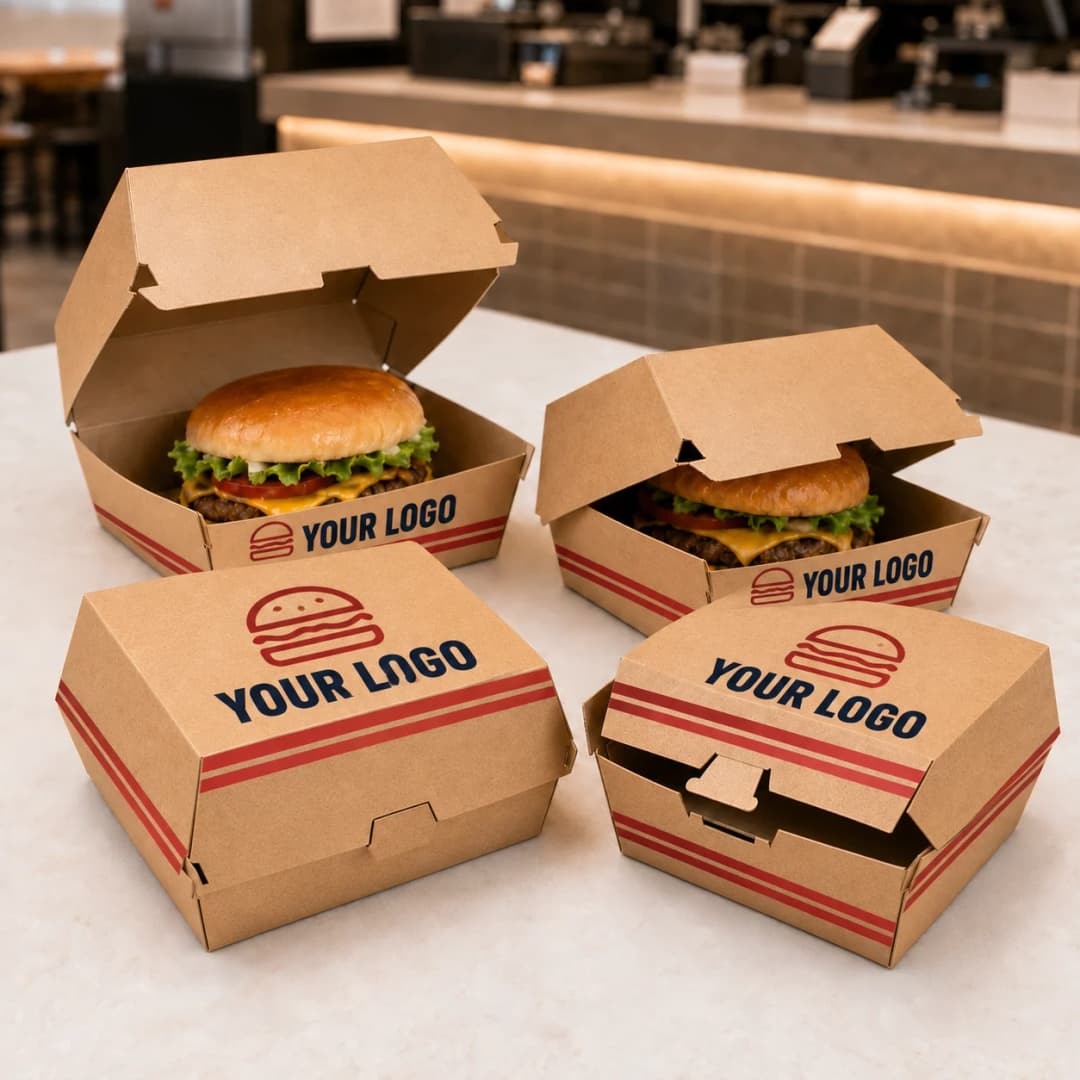
For a burger served in a formed base with a connected lid or another agreed closing arrangement, start with custom burger boxes. Consider the complete burger, including the bun and toppings, and whether the customer opens the pack immediately or carries it first. The lid space and opening direction belong in that decision.
The burger page covers the usable space, closing features and print on the open and closed pack. Use it once the burger is the main item to fit. If the menu includes separate fries or a second snack, decide whether those belong in their own pack before enlarging one box to accommodate everything.
Chicken pieces or a mixed chicken meal
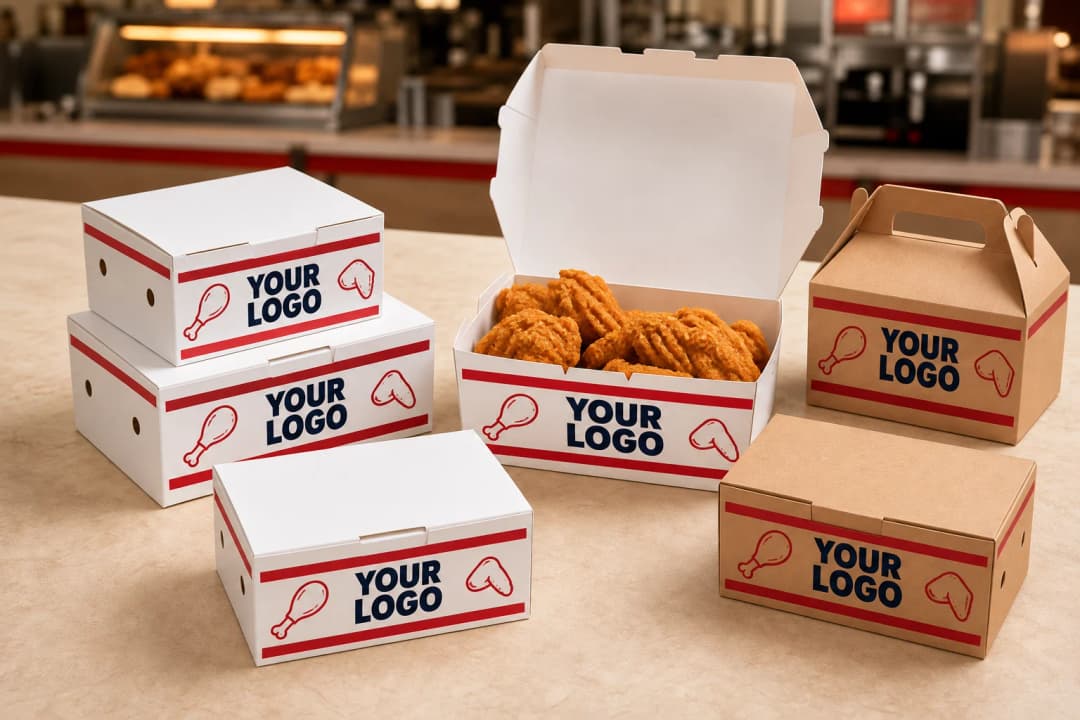
For chicken pieces, wings, nuggets or a broader serving arrangement, compare custom fried chicken boxes. Piece shape, portion size and the way components are arranged matter together. A piece count or a volume label alone does not describe the base area, height and closing space the meal needs.
For a mixed meal, identify what travels inside the chicken box and what travels separately. Fries in their own carton and a sauce container beside the food create a different packing arrangement from one combined portion. The chicken page helps develop the opening and closure around that chosen arrangement.
Fries served from an open carton
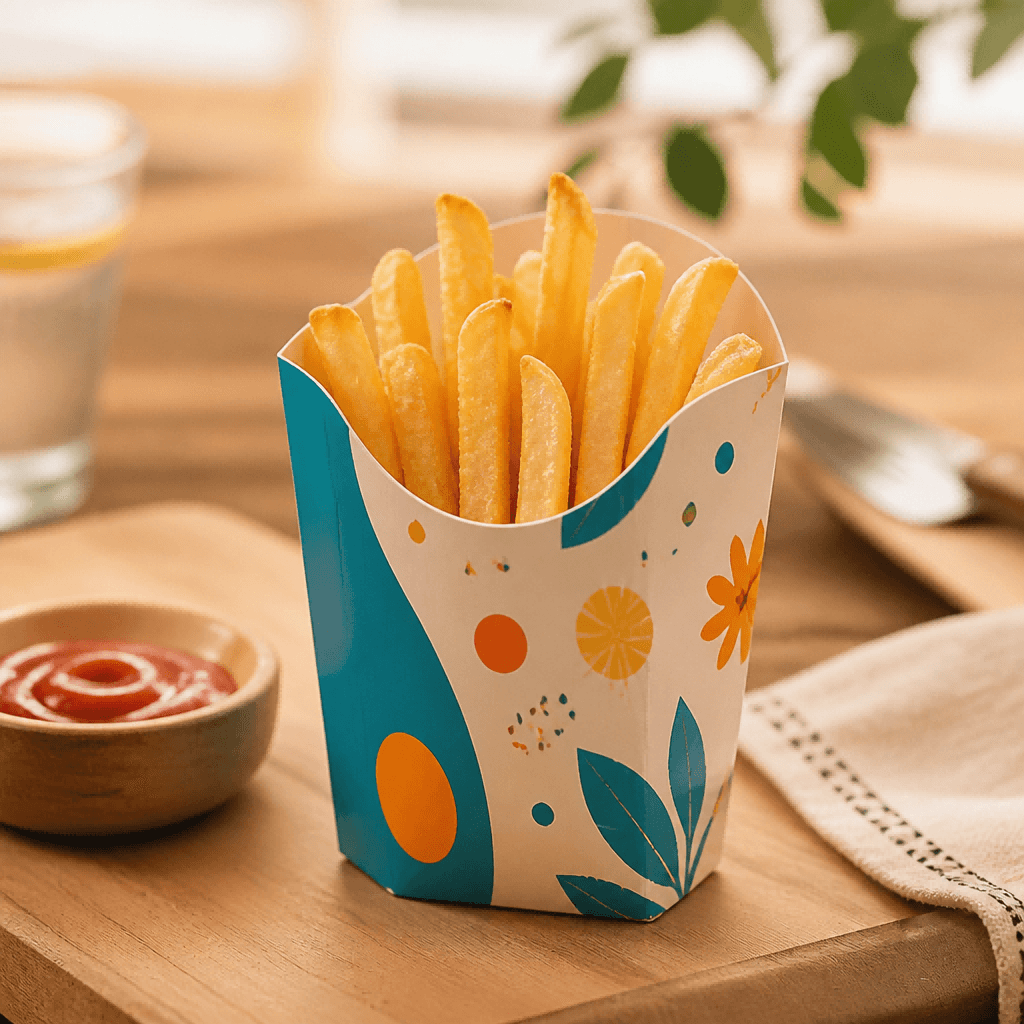
When the customer needs access to fries at a counter, event or concession, custom French fry cartons provide an open serving format. The base, wall profile, opening and gripping area should suit the portion and the way it is handed over. The front can carry a printed design while the food remains accessible from above.
An open fry carton is not a closed delivery box. If it travels with a burger or chicken order, consider the position it occupies in the outer carrier and the handover you intend. Discuss any separate closure requirement with Lynn rather than assuming that an open carton provides it.
A hot dog on an open tray
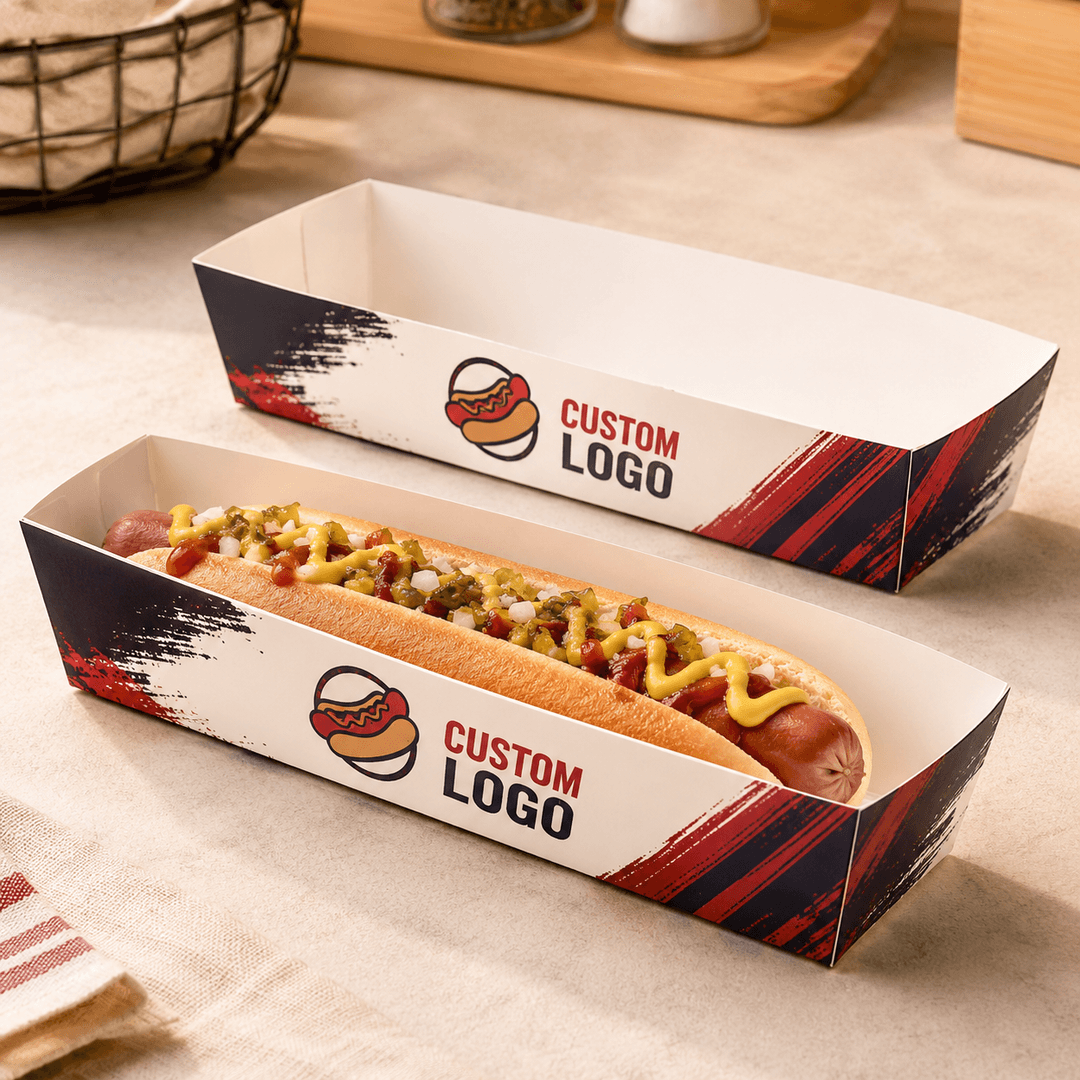
For a hot dog or sausage serving supported from below, start with custom open hot dog trays. Consider the complete bun, sausage and toppings, together with the usable base, side walls and end profile. The customer needs room to grip the tray and reach the serving.
The tray page addresses those open serving decisions. It is a separate product from a fully enclosed hot dog box. If the food must travel in a closing pack, describe that need during the conversation so the proposed structure can be reviewed for that job.
Plan loading, closing and removal as one sequence
The right family should work at both ends of the order: when staff pack it and when the customer eats. A broad opening can change how a mixed meal is placed inside; a hinged lid occupies space when open; tabs and folds affect where staff hold the pack. Compare the complete serving in the proposed formed structure rather than judging an empty flat blank alone.
For a closing box, review whether the meal sits below the lid and clear of the closing features. For an open carton or tray, review the opening, wall profile and customer access. Those are different decisions, even when two packs have a similar footprint or use similar printed colors.
Flat-packed supply, erection at the counter and the way finished packs are stored also belong in the choice. The packing method can be discussed alongside the structure so the proposed format matches your normal workflow. Compare the space staff have for opening, filling and setting down the pack during an ordinary order.
For takeaway or delivery, look at the order as it is handed over: the individual food packs, their arrangement and any outer carrier. Outside box dimensions help with that arrangement; internal dimensions describe the space available to the food. A shared outer measurement does not guarantee the same usable space after the board, folds or closure change.
Show your brand on the formed pack
Custom printing can connect the different packs in your menu through a logo, colors, food graphics and a consistent panel layout. Decide which surfaces the customer sees: a closed lid at collection, a front panel during service, or the sides of an open tray. Plan the printed presentation around those views.
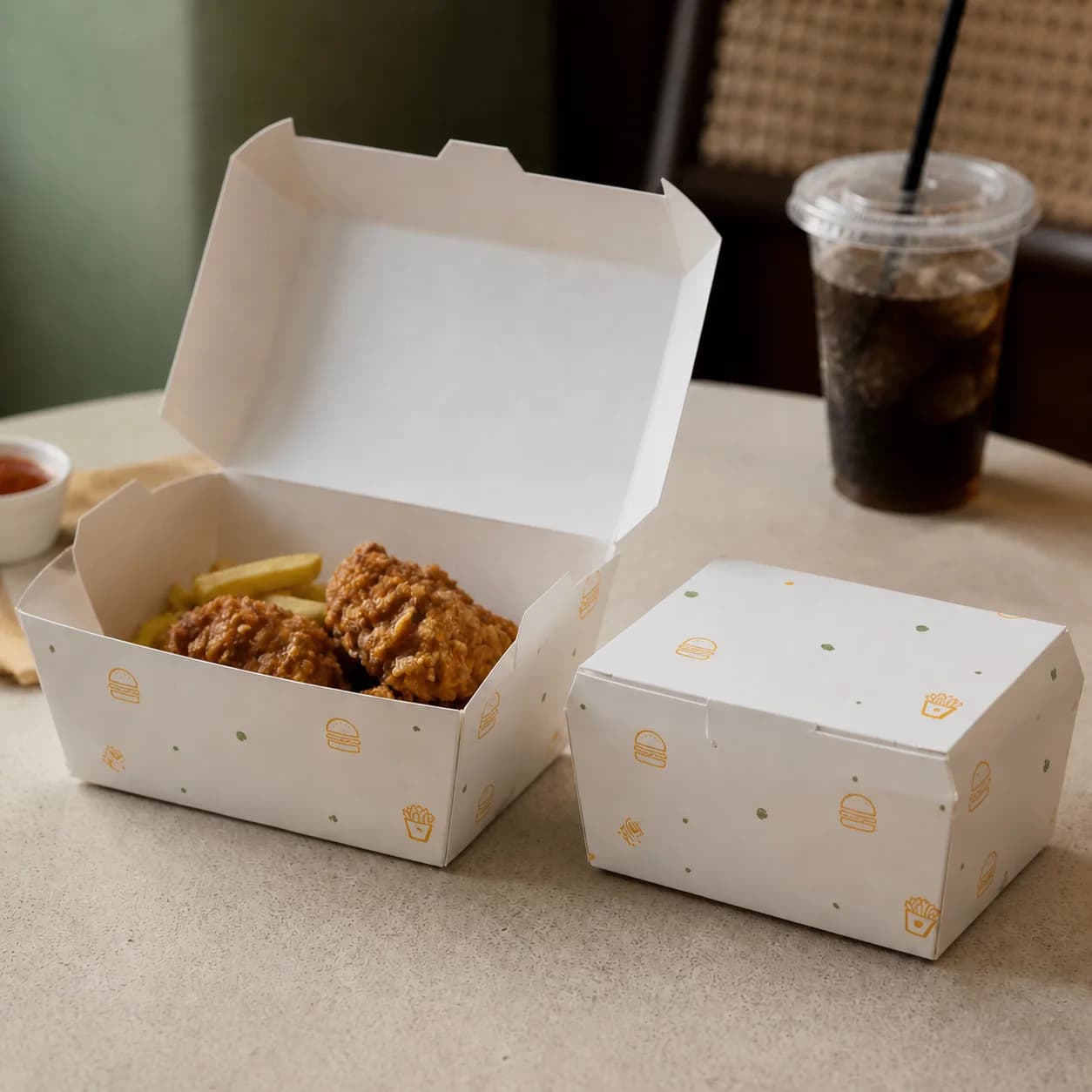
The existing illustration shows white boxes with small burger and fry graphics and green accents, one open with food and one closed. It helps show how the same design appears on a formed front, side and lid. It is an illustration of presentation, not proof of a particular board specification, food-contact approval or customer order.
Review artwork on the proposed dieline and a formed representation, including folds, panel edges and the agreed closing features. A design that reads clearly on a flat layout may appear differently when a panel turns a corner or folds into the closure. Dimensions, structure and artwork should therefore be developed together.
You do not need a finished print file to ask about a packaging idea. Tell Lynn what you would like customers to see; available artwork, print coverage and finishing requests can be worked through after the format is clearer.
Compare the original material and structure routes
Folding paperboard
A compact flat-packed route for meals and snacks when the selected board and barrier suit the food.
The folded shape determines the usable base, walls and closing arrangement. Compare the formed pack with your serving and the way it will be stored and erected. A board description alone does not determine the finished box's suitability for that meal.
Clamshell structure
A one-piece opening and closing format that can simplify counter service.
The connected base and lid give staff a defined loading and closing sequence. Review the open position and the closed clearance with the actual food. A clamshell is a structural choice; it does not by itself establish a grease barrier, a leak result or special temperature suitability.
Barrier-coated board
PE, PP, dispersion or another functional layer may be evaluated when grease or moisture protection is required.
That evaluation belongs to the selected food, board construction and intended use. Discuss oil, sauce, moisture, temperature and the journey before eating so the relevant route and documentation can be reviewed. The listed alternatives are possible evaluation routes, not a promise that every box uses or qualifies for each one.
Develop the selected format with Xucheng
Xucheng coordinates the packaging solution, supply-chain selection, samples, inspection and delivery; production is arranged with suitable partners. The selected structure, board, barrier, print coverage and packing format determine the practical equipment and production route for each project. Flat paperboard moves through converting before forming and packing.
Once a format is proposed, a formed sample connects the design to your own food and service. Review loading and removal, closing clearance where applicable, the printed views and the intended handover. Any food-contact or performance requirement is checked for the final material and use; a photo of an attractive pack cannot establish it.
Existing non-custom samples may be available free of charge with courier costs paid by the buyer. Custom samples are charged, with courier costs also paid by the buyer; the custom sample fee is fully credited against the formal order. The proposed structure, material and artwork are confirmed for the custom sample rather than treated as a fixed catalogue specification.
Details to work through for a project quotation
These six topics help define the final specification and quotation after the first conversation. Share what you already know and develop the rest with Lynn. They are not website fields you must complete before using WhatsApp or Email.
Meal and portion
Describe the food, serving weight, pieces and any separate components.
Include the normal completed serving and any menu variations expected to share the format. The arrangement helps identify whether one box, an open carton or several separate packs make sense for the order.
Capacity or dimensions
Provide internal length × width × height or the required volume.
If dimensions are still open, begin with the food and intended format. Usable base area, lid clearance and the space taken by any separate component can then be reviewed. Keep internal food space distinct from the outside dimensions used for an outer carrier or carton.
Performance
State oil, sauce, moisture, heat and the expected delivery time.
These describe the conditions the proposed pack must be evaluated against. A request for a particular barrier or special temperature use needs the appropriate material review and written support; an open or closing shape alone does not answer it.
Operation
Explain whether boxes arrive flat, how staff erect them and how they close.
For an open format, describe loading, gripping and handover instead of assuming a lid. For a closing format, include the filled pack's closing and reopening sequence. The packing method is considered with the chosen structure.
Print and finish
Send artwork, colors, coverage and any window or finishing request.
Available logos or references can support the discussion, with final files and panel positions confirmed as the design develops. Any requested window or finish is reviewed for the specific structure; it is not a standard feature of every takeaway pack.
Market and quantity
Provide estimated order quantity, destination and required documents.
Those details support the final quotation, production and delivery discussion. MOQ remains flexible by structure, with the practical minimum reviewed against the size, board, coating, tooling, print and packing. A destination address or settled quantity is not required for the first conversation.
Takeaway food box FAQs
How should I choose the capacity?
Measure the real meal and allow practical loading and closing clearance. Capacity labels alone can hide differences in shape, usable base area and lid space.
Does every takeaway box prevent leaks?
No. Board, barrier, folds, corners, closure, food temperature and holding time all matter. Test the selected structure with the actual meal.
What is the minimum order quantity?
MOQ is flexible by structure. Size, board, coating, tooling, print and packing must be reviewed before the practical minimum is confirmed.
Can the box be used in a microwave or freezer?
Do not assume special-use suitability. State the exact temperature and use condition so written support for the final material can be checked.
Can I ask before I have chosen a box type or prepared artwork?
Yes. Describe the food and whether it is served straight away or carried before eating. You can contact Lynn before you have photos, measurements, artwork, an order quantity or a destination address. The format, samples and final quote details can be developed as the project takes shape.
Talk with Lynn about your takeaway pack
Chat on WhatsApp, choose an email option, or leave a brief web message as a backup. Start with your meal and the pack you have in mind; the remaining details can follow.