
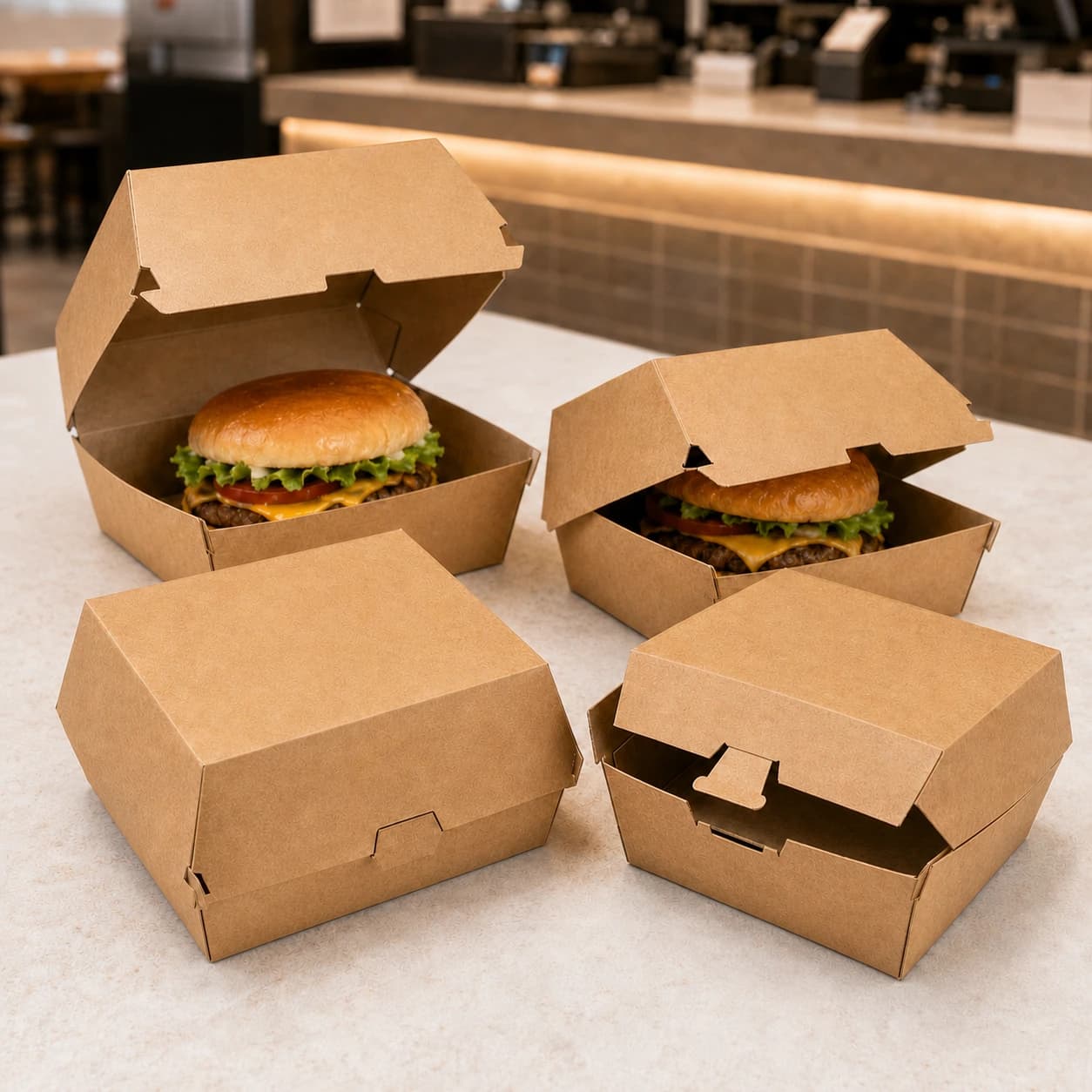
A burger box must fit the finished burger, close reliably and protect it through the intended service journey. This guide explains how to compare paperboard, internal size, box structure, ventilation and sample performance without choosing by gsm alone.
1. Confirm that a burger box is the right format
A burger box is a formed paperboard pack with a base, side walls and a closing lid. It is different from burger wrapping paper, an open paper sleeve or a tray liner.
Choose a box when the burger needs shape protection, stacking support or a closed pack for takeaway. Wrapping paper may be more suitable when compact packing, direct handling or a lower-material format matters more than rigid protection. Some projects use both: a liner or wrap inside the box.
2. Describe the burger and route to the customer
Provide the finished burger width, depth and height, including toppings. Explain whether the box is used for immediate dine-in, counter takeaway, drive-through or delivery.
A tall burger with sauce and a long delivery journey needs a different structure from a small dry burger served immediately. Side items, liners and stacking requirements also affect internal dimensions.
3. Understand common paperboard routes
- Folding boxboard or white paperboard: a lightweight, printable route for folded cartons and clamshells.
- Kraft paperboard: selected when a natural brown appearance is preferred.
- Fluted or corrugated paperboard: adds rigidity and insulation for handling and delivery.
- Barrier-coated paperboard: uses PE, PP, a dispersion coating or another functional layer when stronger grease or moisture performance is required.
Do not use gsm as a strength guarantee. Fibre structure, thickness, grain direction, creases, locks and the assembled shape all affect performance. Compare the selected board in a finished-box sample under the intended load.
4. Select the structure around operation and delivery
A one-piece clamshell combines the base and lid and can simplify packing. Other folded structures may offer different locking, stacking or display benefits.
Check:
- whether staff can erect and close the box quickly;
- whether the lid remains secure in a delivery bag;
- whether the base supports the food without bowing;
- whether ventilation is needed to manage steam;
- whether the box stacks without crushing the burger;
- whether a liner, sauce cup or side item must fit inside.
Ventilation is a balance: releasing steam may help texture, while excessive opening can reduce heat retention or expose the food. Test the sample in the actual service journey.
5. Separate strength from grease and moisture performance
Paperboard stiffness helps the box retain its shape. A grease or moisture barrier helps prevent staining, softening or leakage. These are different functions.
Tell the supplier about oil, sauce, condensation, contact time and temperature. If microwave, freezer or another special use is required, request written confirmation for the final material instead of assuming every paperboard box is suitable.
Xucheng does not currently claim company-held certifications. If your market requires a specific food-contact document or test, state it before quotation so availability can be checked for the selected material and production partner.
6. Plan dimensions from the inside out
State whether measurements are internal or external. Internal dimensions are normally more useful for food fit, while external dimensions affect master cartons, storage and delivery bags.
Allow space for the maximum burger diameter and height, toppings that should not touch the lid, a paper liner, easy loading, ventilation and closing tabs, and reasonable movement control during delivery. Avoid copying only the external dimensions of an existing box because board thickness and structure can change the usable internal space.
7. Test printing on the selected board
White coated board, uncoated board, kraft and fluted surfaces do not reproduce color in the same way. Confirm board color, print colors, coverage and finishing before artwork approval.
A digital mockup can check panel position, but a physical sample is needed to verify folds, locks, stiffness, print appearance and the complete food-service test.
8. Run a loaded sample test before approval
Use the actual burger, not an empty-box inspection. Record the burger dimensions, loading temperature and test time so competing samples are compared under the same conditions.
Check whether:
- staff can erect, load and close the box consistently;
- the lid and locks stay secure during bagging and transport;
- toppings or the bun touch the lid;
- the base bows, stains or softens;
- steam management is suitable for the required holding time;
- stacked boxes protect the burger without excessive movement;
- the print remains acceptable across folds, creases and board color.
Testing one variable at a time makes the result easier to interpret. For example, keep the structure constant when comparing boards, or keep the board constant when comparing ventilation patterns.
Burger box quotation checklist
- Maximum burger width, depth and finished height
- Dine-in, takeaway or delivery
- Internal box dimensions if known
- Food weight, oil, sauce and steam level
- Required holding time
- Preferred clamshell, fold-lock or current reference structure
- White, kraft or fluted appearance
- Printing colors, coverage and artwork
- Estimated quantity and packing method
- Delivery country and required food-contact or performance documents
Frequently asked questions
Is a higher-gsm burger box always stronger?
No. Fibre structure, thickness, stiffness direction, flute profile, folds and locking design all affect finished strength. Compare the assembled sample under real load.
Should a burger box have ventilation holes?
It depends on the food and service time. Ventilation may release steam, but the number and position should be tested against heat retention and delivery protection.
Can the dimensions and printing be customized?
Yes. Dimensions, board, structure, print and packing can be developed around the project. Final feasibility and MOQ are confirmed after reviewing the specification.
What should I send if I do not have a dieline?
Send the maximum burger dimensions, photos of the loaded pack and, if available, an unused flat sample of the current box. A proposed dieline still needs a physical sample and loaded-box test before bulk production.
Discuss your box project
View our custom burger boxes, compare custom burger wrapping paper, or review paper bags for the outer takeaway pack. Send Lynn the food dimensions, quantity, artwork, service method and delivery country for a project-specific review.