
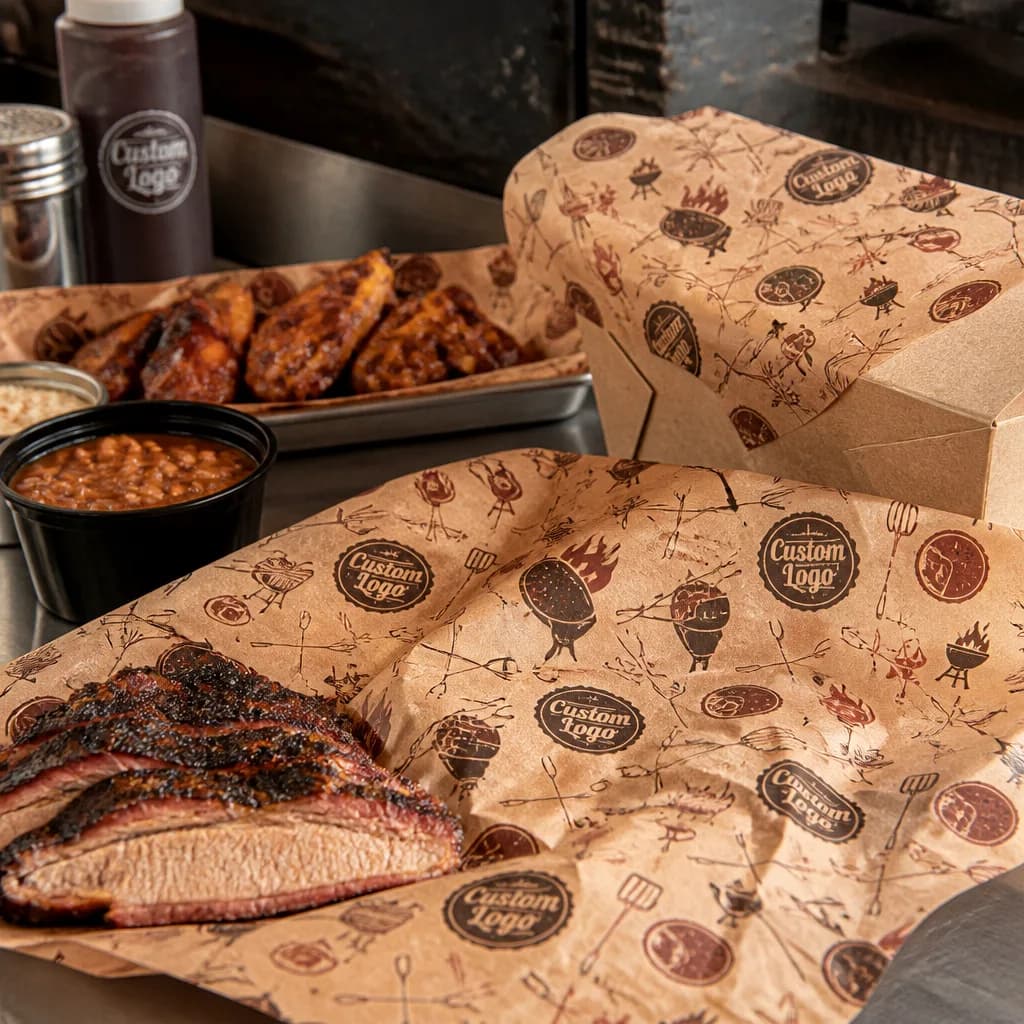
The words “BBQ paper” are not enough for a supplier to quote the correct product. They can describe pre-cut printed sheets used at a cooked-meat counter, a continuous printed food-service roll cut to length, or a specialist butcher paper intended for a cooking process. Those products may look related, but the buyer decisions are different.
Start with the physical supply form and the actual service step. If staff pick up one ready-sized piece for every tray or portion, review custom printed BBQ deli paper sheets. If staff pull a web from a holder and cut the length needed for each job, review a custom printed BBQ paper roll. Do not assume that either format is suitable for a smoker, oven or other heated process unless the selected paper and its use limits have been confirmed.
Decide where the paper enters the workflow
Map one normal order from the preparation area to the customer. Note when the paper is taken from storage, whether it touches a tray or the food, how it is folded, how long it remains in contact and where the printed surface is visible.
Pre-cut sheets remove the cutting step. They can be stacked near the service point and picked up as a repeatable finished size. This is useful when portions, trays and wrapping movements are reasonably consistent. The trade-off is that the finished dimensions must cover the real range of portions without creating excessive folds or unused paper.
A roll lets staff choose the cut length. It can suit operations that line different platter lengths or wrap portions with greater size variation. The roll also adds another set of decisions: holder clearance, core fit, outside diameter, unwind direction, cutting method, counter space and the time required to separate each piece.
Observe the station during a busy service period rather than reviewing the format only on an empty table. A roll that saves paper in theory may slow the hand-off if the cutter is awkward. A fixed sheet that looks efficient may be too small for the largest normal order or unnecessarily large for most portions.
Use portion consistency to choose the starting format
List the smallest, typical and largest portions sold in the same service process. Include the tray, platter or basket when the paper is used as a liner. Measure the area that actually needs coverage, not just the nominal food weight.
Pre-cut sheets are a practical starting point when one or two sizes cover most orders. Make full-size blanks from ordinary paper and test them with the real food and container. Record whether one sheet is enough, whether folds interfere with serving and whether staff can separate a single piece quickly.
A roll deserves a separate trial when the required length changes frequently, large platters fall outside a useful sheet size, or staff already use a suitable roll holder and cutter. Record the length used for each representative job. The result provides a more reliable roll-width and usage brief than a general request for a “standard BBQ paper roll.”
Do not treat the format choice as proof of material performance. Sheet and roll versions can still require different base papers, treatments or contact documentation. The actual food, temperature, oil, sauce, moisture, contact time and destination market remain part of the material review.
Compare the full station cost, not only paper area
Paper use matters, but it is only one part of the operating decision. Review the following during the trial:
- time to take one sheet or cut one length;
- counter and storage space;
- dropped, torn or incorrectly sized pieces;
- whether staff use more than one sheet for larger portions;
- cutter access and safe hand movement;
- restocking frequency;
- how opened packs or rolls are protected during service;
- whether the format remains consistent across locations.
For a multi-location restaurant, pre-cut sheets may make portion handling easier to standardize. A roll may reduce the number of stocked sizes but needs a consistent holder, cutting method and training process. The right result is the one that works during actual service, not the one that appears simplest on a supplier list.
Build artwork for the used paper, not the flat file
Repeated artwork behaves differently on sheets and rolls. On a pre-cut sheet, the repeat should still look intentional after the paper is folded around food or partly hidden by a tray. A fixed-position design needs even tighter control because food placement and folding can cover the intended message.
On a roll, confirm the repeat length and unwind direction. The design may appear upright on the production file but rotate or disappear after the web feeds through the holder and the operator cuts a normal service length. If portions use different lengths, test the shortest and longest pieces so the brand does not vanish from one of them.
Use a printed sample or an accurately scaled mock-up. Load the food, complete the normal fold or liner setup and photograph the result from the customer’s viewing angle. Check small text, logo spacing and any QR code after grease, folds and shadows are present. Do not approve the artwork only from a clean digital layout.
Keep smoker paper as a separate technical decision
Some butcher papers are made and marketed for wrapping meat during low-temperature smoking. That use does not follow automatically from a pink, brown or BBQ-themed appearance, and it does not follow from the fact that the paper is supplied on a roll.
If the paper will enter a smoker or another heated process, state that use at the beginning of the request. Ask the supplier to identify the proposed paper construction, treatments, temperature and contact limitations, and the documents required for the destination market. Keep this technical brief separate from a printed service paper used only after cooking.
Xucheng’s printed BBQ paper pages therefore describe the visible supply forms and the information needed for a project review. They do not assign a universal paper grade, treatment, grease rating or smoker suitability to every sheet or roll.
Run a two-format service trial
A useful comparison can be completed with a small set of blanks or representative samples.
- Select the smallest, typical and largest normal cooked-food portions.
- Prepare one or two candidate sheet sizes and a representative roll width.
- Place the materials at the real storage and dispensing points.
- Ask staff to line, wrap and hand over each order using the normal sequence.
- Record pickup or cutting time, paper waste, fold quality, tray coverage and print-visible area.
- Repeat the test after the paper has remained in contact for the expected holding period.
- Photograph the successful and failed setups and record the exact dimensions used.
The failed samples are valuable. A sheet that leaves one corner exposed requires a different correction from a sheet that creates excessive folds. A roll that fits the holder but feeds with the print upside down requires an unwind correction, not a material change.
If the paper is mainly used to line a fixed reusable serving tray, the measuring decision may be better handled through the separate paper tray liner sizing guide. General deli paper sheets also remain a separate category when the job is ordinary deli pickup, separation or wrapping rather than a barbecue-specific printed service system.
Prepare a quote brief for sheets
For pre-cut BBQ deli paper sheets, send:
- the cooked food and whether the paper wraps it or lines a container;
- finished sheet width and length;
- tray, platter or basket dimensions when relevant;
- food temperature, oil, sauce, moisture and expected contact time;
- requested paper or performance information, if already known;
- artwork, print colors, repeat direction and visible area;
- sheets per inner pack, estimated total quantity and delivery country;
- any document the selected material must support.
Prepare a quote brief for a roll
For a printed BBQ food-service roll, send:
- the cooked food and the normal cut-to-length use;
- roll width and roll length;
- core inside diameter and maximum roll outside diameter;
- holder, dispenser or cutter photos and dimensions;
- unwind direction and preferred print repeat;
- food conditions, paper requirements and expected contact time;
- protection, roll labeling, rolls per carton, quantity and destination;
- a clear statement if the paper will enter a heated cooking process.
Frequently asked questions
Can the same paper specification be supplied as both sheets and rolls?
It may be possible for some projects, but it should not be assumed. Converting, printing, roll construction, sheet cutting and packing can change the practical specification. Ask for each finished format to be reviewed and sampled.
Are pre-cut sheets always faster at the counter?
They remove the cutting step, but the result still depends on pack opening, sheet separation, size fit and station layout. Test the actual pack and the busiest service sequence.
Does a roll always reduce waste?
No. Variable cut length can reduce excess paper in some operations, but inconsistent cutting, damaged roll ends or staff taking extra length can offset that benefit. Record real usage during the trial.
What should be approved before bulk production?
Approve the physical format, dimensions, material route, intended contact conditions, artwork, colors, repeat, viewing direction, packing and any required documents. For a roll, also approve the core, outside diameter, unwind direction and cutter fit.
What information should be left open for supplier confirmation?
When no approved specification exists, leave base paper, treatment, grammage or caliper, performance, food-contact documents, MOQ, lead time and packing as project-confirmation fields. Do not replace missing facts with values copied from a different supplier’s product.