Specify an insulated carry bag around the food containers you use and the journey they need to make. Xucheng Packaging coordinates custom bag projects for takeaway meals, bakery boxes and mixed food orders, with dimensions, handles, closure and printing reviewed against the intended load.
Send the packed-order dimensions, a photograph of the arrangement, your quantity and delivery country. Explain the temperature requirement and normal handling conditions so the proposed bag and sample checks address the actual job. The appearance of a lining alone is not a performance specification.
Start with the complete packed order
The containers inside the bag determine its usable footprint and height. Measure closed food boxes at their widest points, including lid flanges, handles or tabs. For a bakery order, include the cake board or outer carton rather than measuring only the cake. For stacked meals, measure the complete stack and note which containers can safely carry another container above them.
Draw or photograph the normal arrangement from above and from the side. Identify the heaviest load and any smaller order that must use the same bag. If a side dish is usually added, include it in this arrangement; leaving it out of the sizing brief can force staff to tilt the main container at packing time.
An insulated bag is outer packaging. It does not replace a food container's closure, grease barrier or suitability for contact with the food. Keep these requirements with the inner packaging specification so that a bag lining is not treated as a substitute for a suitable food box.
Choose the footprint before adding height
A tall bag can still be unsuitable for a wide, shallow carton. Begin with the base dimensions and check that staff can lower the closed box into the opening without bending its sides or catching its corners. Then allow for the complete order height, the intended closure and the clearance needed to remove the contents.
Ask how the proposed dimensions are measured. Outside dimensions do not necessarily describe usable interior space: seams, lining, folds and closure details can occupy part of it. Review the finished sample with the intended containers instead of approving solely from a flat drawing.
If different menus use very different footprints, compare separate bag sizes against one larger bag. A larger bag reduces the number of versions to store, but extra space can allow containers to shift. Separate sizes can improve fit while adding purchasing and stock-control work. Test the arrangement you actually intend staff to pack.
Review opening, closure and handles as one assembly
The opening must accommodate the widest container as it is packed, not only once it is sitting inside. Check access while the bag is on the counter and whether staff need both hands to keep the opening clear. For a cake or other presentation-sensitive item, include removal by the customer in the trial.
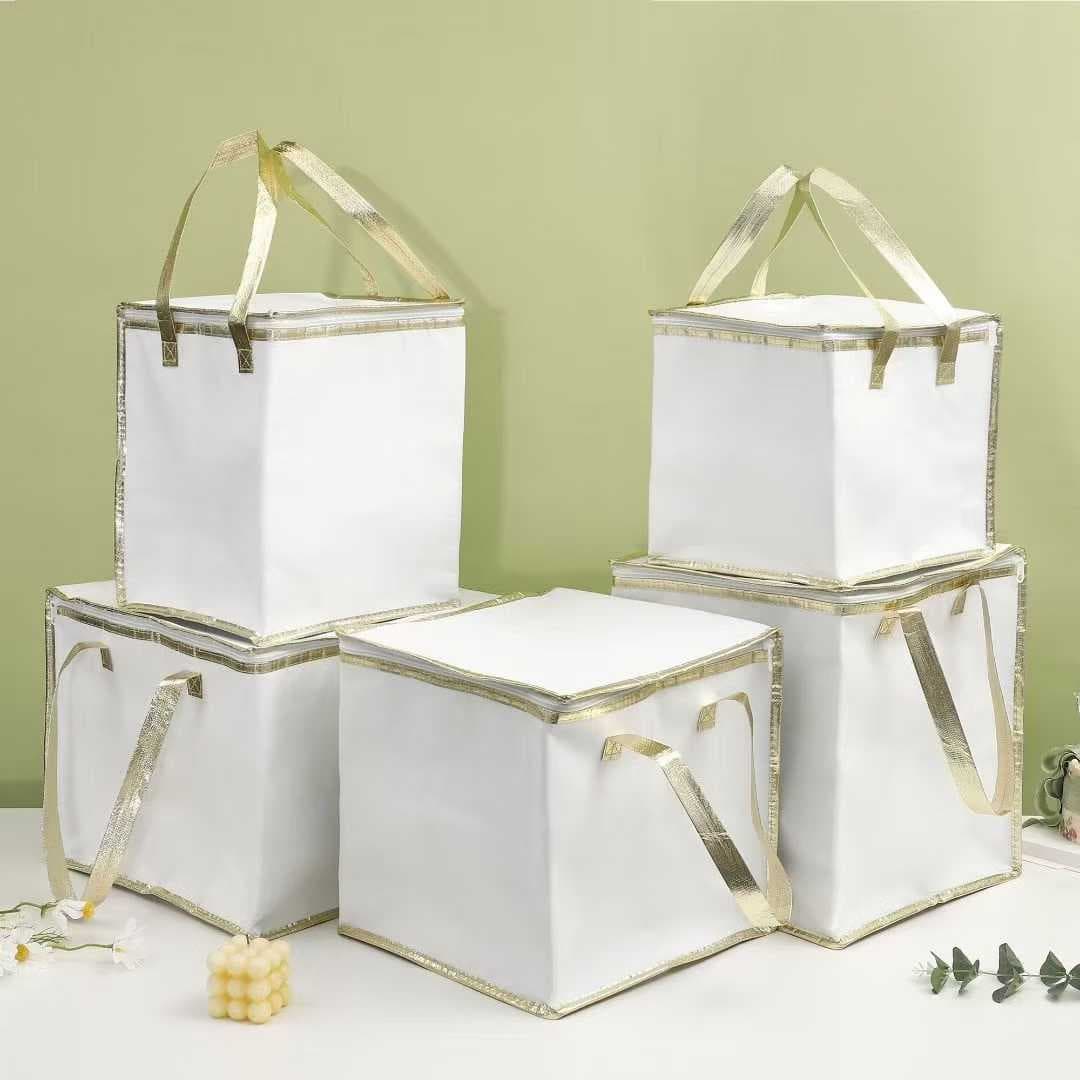
A zipper, fold-over top or other proposed closure affects loading speed, usable height and how the bag is opened during the journey. Send your preferred style or an example for review. Keep the closure method explicit in the quotation; a photograph of a closed bag does not describe its construction adequately.
Handle placement changes how the loaded bag hangs. Check whether the base stays level, whether handles draw the sidewalls into the containers and whether the customer can carry the order comfortably. Specify the actual packed weight for sample evaluation rather than selecting a handle only for its appearance.
For multi-item orders, identify which item must remain upright and which can tolerate contact with another pack. An illustrated divider or support is not automatically part of the bag supply. List any such components and state who supplies them.
Turn the temperature requirement into a sample brief
Describe whether the project concerns hot meals, chilled products or another defined use. Record the condition at packing, expected journey length, likely surroundings and how often the bag will be opened. If hot and cold items travel together, review how they will be separated rather than assuming one shared space serves both requirements.
Agree what will be measured and what counts as an acceptable result. Test the proposed finished construction with a representative load, its normal inner containers and the intended closure. An empty-bag demonstration cannot stand in for the packed order, and a short counter handover does not establish performance for a longer delivery route.
Discuss the proposed exterior, insulating layer and inner surface as separate parts of the specification. A silver-coloured inner surface does not identify its composition or establish a holding time. Xucheng reviews the construction for the project; material layers and performance claims should match the agreed specification and supporting evidence.
The bag is one part of the delivery process. It does not independently establish compliance with food temperature requirements. Where the operation has a defined temperature-control procedure, use that procedure to set the bag trial and acceptance criteria. We do not promise a universal number of hot-or-cold hours across different custom bags and loads.
Include moisture, spills and repeat use in the review
Warm containers can release moisture, while cold packs can produce condensation. Check the inner containers, bag base, seams and closure after the intended journey. A surface that can be wiped does not by itself make the entire assembled bag leakproof.
If a pack leaks during the trial, distinguish the inner-container issue from the outer-bag requirement. Decide whether the order needs a different food-container closure, a separate containment measure or a change to the carrying arrangement. Do not use a claimed bag property to conceal an unsuitable food pack.
If repeat use matters, state how the bag will be stored, handled and cleaned. Review the proposed material and care instructions with the sample. Do not assume that a bag intended for more than one use is machine washable or suitable for every cleaning agent.
Place the artwork where it will remain visible
Provide the print file, colours, desired panels and any label position. Review the artwork on the agreed formed-bag layout, including seams, handles, gussets and closure zones. A logo centred on a flat panel may be partly hidden when the loaded bag is held by its handles.
Keep essential instructions and contact details readable at the intended size. If staff add an order label, reserve a practical area that does not interfere with the closure. Confirm colour and surface appearance on the agreed physical sample where they are important; a screen preview establishes layout rather than a finished material match.